
Walking Village to Village: Socio-Economic Baseline Surveys
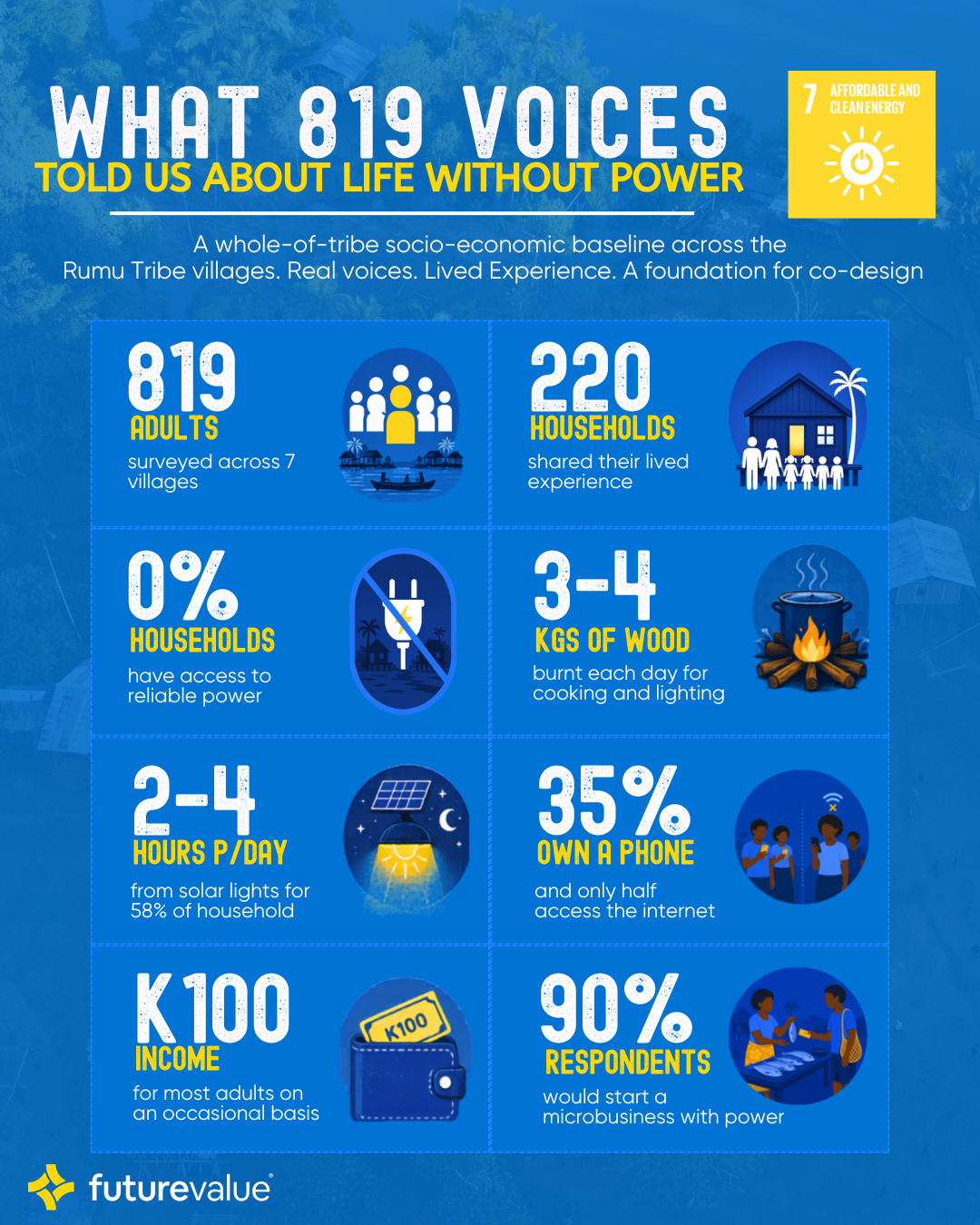
A baseline survey in Rumu Tribe villages showed that rural electrification needs to be designed around community priorities, local participation and livelihood opportunity, not technical assumptions alone.
If energy access is meant to improve lives, communities need to be able to define what improvement actually looks like. In Papua New Guinea, that principle shaped baseline work connected to an Energy Catalyst Round 10 project, a program led by Innovate UK to support clean, affordable and accessible energy solutions in underserved markets.
Starting with listening
The baseline socio-economic survey was built into the project from the beginning because electricity was never treated as a simple technical input. The aim was to understand how people in Rumu Tribe villages were living, what they valued most, and how they believed access to power could affect daily life, livelihoods and future opportunities.
That matters because co-design only has substance when it is grounded in what communities say they need, rather than what outside actors assume they need. A baseline, when done properly, becomes more than a measurement exercise; it becomes an early design tool that helps align infrastructure planning with social and economic reality.
Broadening whose voice is heard
A central part of the survey design was inclusion. Rather than relying only on the perspective of the household head, the approach aimed to create space for every adult who wanted to participate, recognising that energy access affects women, men and other household members in different ways.
This kind of approach is especially important in remote service delivery contexts, where decisions are often shaped by a narrow set of voices. If a project is serious about co-design, then participation has to be broad enough to capture lived experience across the community, not just formal authority.
Building local ownership
Local participation was not limited to answering survey questions. FutureValue involved local men and women in the delivery of the survey itself through recruitment, training and field implementation, strengthening trust in the process and helping ensure the work was locally grounded.
That model reflects a wider development principle: stronger local ownership often produces better data, better relationships and better long-term delivery conditions. In contexts where trust, language and customary relationships matter, who gathers information can be just as important as what information is gathered.
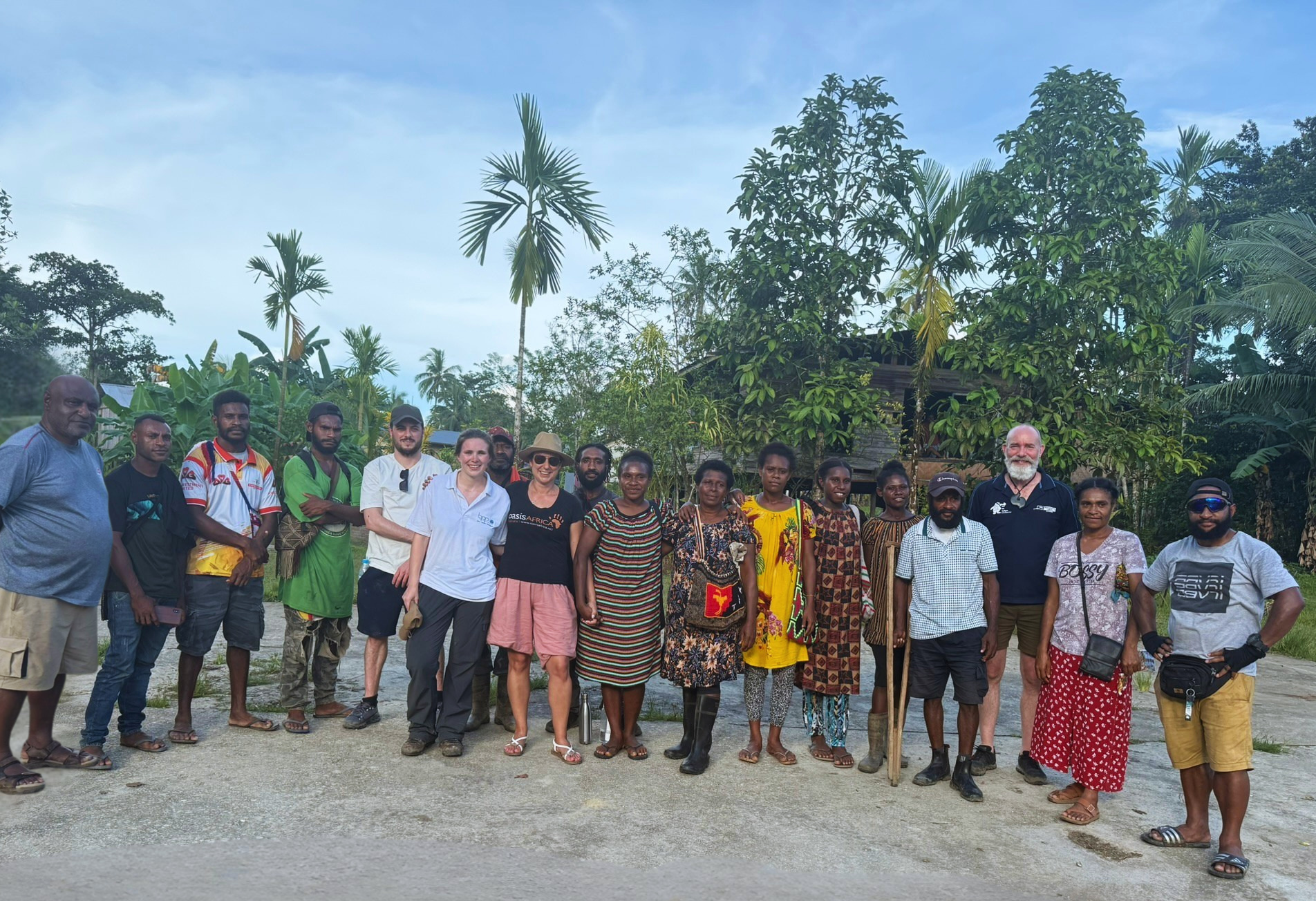
Image: FutureValue - 4 March 2025: Survey Team in Kopi Village, Kikori District, Gulf Province
Working through field realities
Fieldwork in remote Papua New Guinea is rarely straightforward. Geographic isolation, weak connectivity and operational constraints are common features of energy access work in these settings, and projects in Kikori District of Gulf Province already sit within areas facing deep infrastructure and service gaps.
Against that backdrop, completing a large baseline required persistence as much as planning. Language barriers, inconsistent network coverage and technical issues may sound operational, but they shape how inclusive, reliable and usable a dataset ultimately becomes.
What the survey revealed
The completed survey reached 819 adults across 220 households, creating a substantial evidence base on how people experience life without reliable access to power. The findings pointed to a clear message: energy access could not be considered in isolation from livelihoods.
Reported incomes showed that paying for electricity would be difficult for many households without stronger and more stable earning opportunities. At the same time, around 90% of respondents said access to power could help them start or expand a micro-business, while many also linked electricity to skills development and future employment.
Taken together, those findings suggest that the value of rural electrification lies not only in lighting or device charging, but in the opportunity ecosystem that electricity can unlock. In practice, that means energy planning should be paired with livelihood development, enterprise support and realistic affordability pathways.
From baseline to better design
The strongest baseline studies do not sit on a shelf as project compliance documents. They help shape implementation choices, reveal barriers early and give delivery teams a more credible basis for co-design.
For FutureValue’s work in Papua New Guinea, the survey reinforced a simple but important idea: energy access is the beginning, not the end point. When early-stage work is rooted in trust, local participation and practical evidence, projects are far better positioned to translate infrastructure into opportunity.
For organisations working in Papua New Guinea, effective delivery starts with trust, local relationships and strong groundwork. FutureValue supports partners to turn early engagement into practical pathways for implementation.