Why does energy access matter so much in rural Papua New Guinea?
#TheMorerePawaStory
Sustainable Development Goal 7 #SDG7 calls for access to affordable, reliable, sustainable and modern energy for all. In the context of #PapuaNewGuinea, that objective is not merely a matter of infrastructure provision. It is a development imperative that sits at the intersection of poverty reduction, service delivery, climate resilience, and economic inclusion.
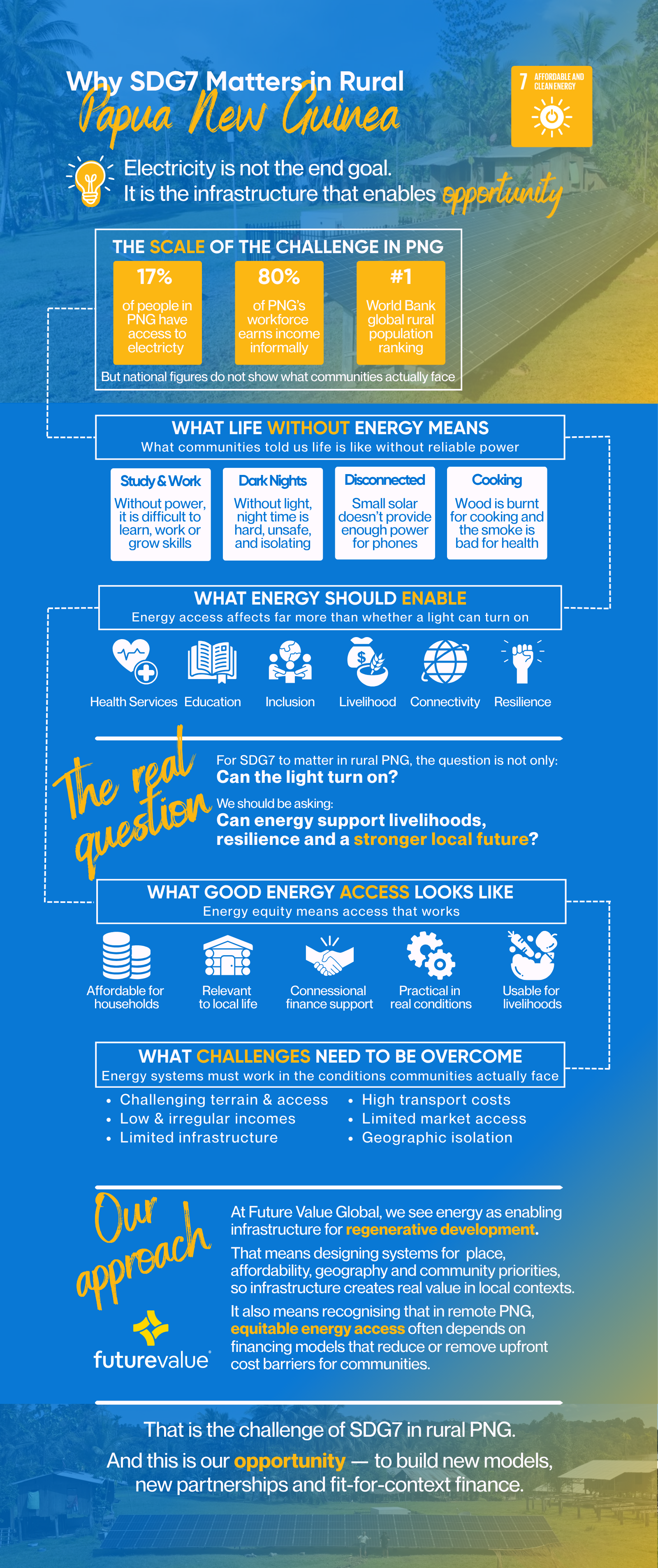
Across PNG, only 17% of people have access to electricity, with the majority of that access concentrated in urban centres. In the Kikori District of #GulfProvince, the challenge is acute: In the remote and riverine communities FutureValue is working with, electricity remains largely absent from everyday life, despite the central role it plays in national development policy. In these village households, none have access to reliable electricity (and we know, because we’ve surveyed many). The reality is staggering: zero percent (0%) access.
The consequences for families are significant. Without reliable energy, health services are constrained, students cannot easily study after dark, communications remain limited, and local enterprise struggles to emerge or grow. The cost of energy poverty is not just technical. It is social, economic and environmental.
In remote PNG, the question is not only whether electricity can reach a community. It is whether it can do so in a way that is affordable, practical, and relevant to local life. A commercial microgrid may make sense in a larger centre, supported by businesses, but that does not mean the same model is viable in remote villages reached only by river. Where incomes are low and irregular, transport costs inflate the price of goods, infrastructure is limited or non-existent, and the gap between a policy target and a workable local system can be enormous.
Under such conditions, conventional market-based approaches to energy access are often neither affordable for households nor commercially attractive for providers. Where need is high but returns are limited, implementation will often depend on public, concessional or catalytic finance that can reduce upfront cost barriers and make investment possible. The challenge is therefore not simply one of grid extension or consumer demand. It is one of designing energy systems and delivery models that respond to place, affordability, geography, and lived reality.
This is why SDG7 matters so much in the PNG context. Not because electricity is an end in itself, but because it is enabling infrastructure for further development.
Papua New Guinea has articulated this importance through several national policy and planning frameworks. #Vision2050 positions long-term national development within a broader agenda of social and economic transformation. The Development Strategic Plan 2010–2030 identifies expanded electricity access, particularly in rural areas, as a core development priority, including through off-grid renewable solutions. The National Energy Policy 2017–2027 further reinforces the State’s commitment to affordable, competitive, and reliable energy access, including a target of 70% electrification by 2030. More recently, PNG’s #Reset@50Roadmap strengthens the case for #RenewableEnergy by identifying universal power and internet access as a core national reform priority, with specific emphasis on ruraloff-grid #SolarEnergy, micro-hydro and wind solutions to improve livelihoods, resilience and inclusivity in remote communities.
Yet the gap between policy ambition and lived reality remains considerable. With less than four years remaining until 2030, the urgency is clear: PNG remains far from its electrification goal, particularly in rural and riverine areas where access continues to lag well behind national ambition.
This matters because #SDG7 is not only concerned with whether electricity exists in a technical sense. It is fundamentally about #EnergyEquity. Is energy affordable, reliable, and modern enough to support meaningful #CommunityDevelopment? In rural PNG, the answer is too often no.
For rural PNG, the more meaningful question is not simply whether a light can turn on. It is whether energy access can support livelihoods, resilience, and a stronger local future. In that sense, SDG7 is deeply connected to wider development outcomes. It underpins opportunity. It shapes what communities can do, not just what technologies they can receive.
And this is why it matters so much to us at Future Value Global. It underpins regenerative development by giving communities control over what it is implemented in their communities and how infrastructure provides benefits within local contexts.
PNG’s national ambitions are important, but for those ambitions to mean something in villages far beyond the road network, the renewable energy ecosystem – policy, finance, capacity building, climate resilience – must meet communities where they are now and aspire to be in the future.
That is the challenge of SDG7 in rural PNG.
And this is our opportunity.
⚡🌏 Energy access is the beginning. Opportunity is what follows.