
Designing for the Energy Ladder: Renewable Energy Microgrid for Remote Communities
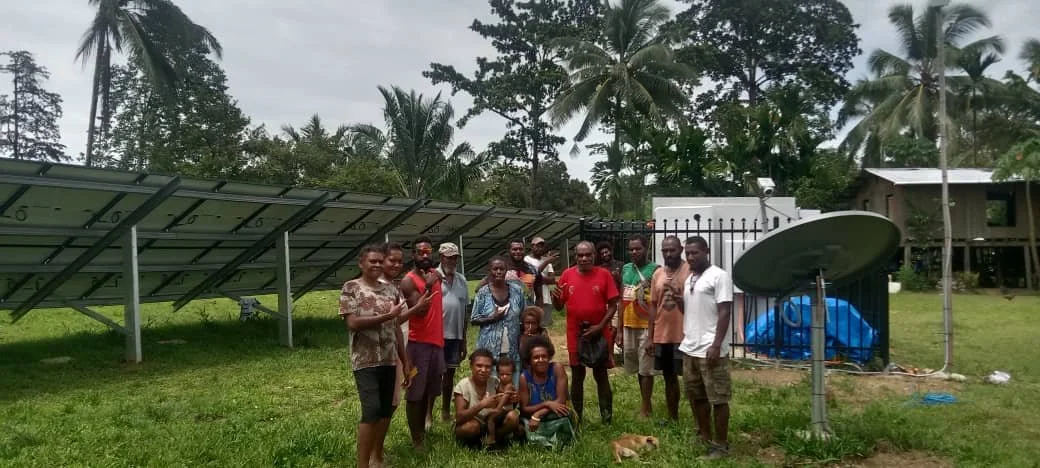
FutureValue Image: Members of the Morere community standing with their new solar array, battery and inverter stack, walk‑in chiller and VSAT system
For remote communities in emerging economies, Sustainable Development Goal 7 (SDG7) – affordable, reliable, and modern energy – is all about energy access. It is critical to eradicate poverty, catalyse economic growth, and support public health and education, for example through digitisation. Achieving SDG7 in remote areas provides the foundational infrastructure to transition these communities into improving living standards and self-sustaining economies. That means designing for the energy ladder.
In Morere Village in the Kikori Delta of Papua New Guinea, the story of energy access and electrifying a community began with questions:
How much power does a family and/or household need when they switch on for the first time?
What happens to energy demand, not just in the first months, but five years down the track?
And how do you design a system that can grow with people’s aspirations, providing a pathway to move up the energy ladder?
This Energy Catalyst Round 10 renewable energy project was built around those questions, leading to a technical, co-design and deep learning process: where consortium partners, FutureValue and BPP Tech, discovered how to match technical modelling and design with the realities of a humid, off‑grid remote river community.
Starting with people, not hardware
Before anyone talked about kilowatts, the FutureValue team listened to households describe how they lived without electricity, lit their homes, kept in touch with relatives, and what they hoped power might mean for their futures. At the same time, BPP Tech was busily researching previous studies of newly electrified communities to put numbers around those stories.
From this work came the first key modelling graph: a daily household power demand curve profile showing expected household energy use over five years. Immediately after electrification, the team predicted that an average household in Morere would use about 0.67 kWh per day, mostly for lighting and phone charging. That is the “first rung” of the energy ladder: small loads that transform safety and communication but draw relatively modest power.
The same graph then extends upward. As families gain confidence and incomes allow, some are expected to buy appliances such as rice cookers, small electric stoves and personal fridges. By Year 5, average demand is projected to rise to around 1.2 kWh per household per day.
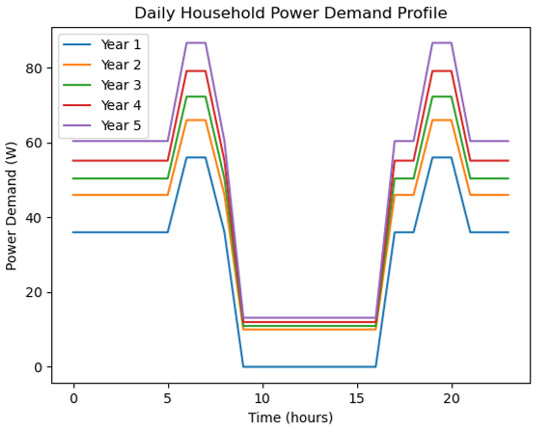
Modelled daily household power demand over five years, showing how average usage is expected to rise from first‑light loads to higher‑rung appliances on the energy ladder
Choosing the right kind of village system
Once the team understood how demand was likely to evolve, the next question was how best to meet it. Here, too, the approach was comparative and pragmatic.
Two options were on the table:
A decentralised system, where each home, or a small cluster of homes, installed its own panels and batteries and managed its own supply.
A centralised system, with solar generation and batteries located in a shared village hub, distributing power out to all households.
On paper, decentralised systems can look attractive. They evoke ideas of energy independence and can be easier to pilot in very small communities from a low cost. But when the team laid five‑year demand profile against real battery price curves, a different story emerged.
Our modelling showed that the cost per unit of energy stored for many smaller systems is significantly higher than for one well‑designed, larger energy bank. When the modelling compared the two scenarios, the centralised system was clearly more cost‑effective over the medium term. It delivered power to all households at a lower cost per unit and created a shared platform on which community‑level services could be added and indeed expanded. Further, it allowed for household energy demand growth over time, rather than locking in households to limited capacity small systems that prevent progress along the energy ladder.
For this project, it became clear that a centralised system would deliver electrification and SDG7 objectives for the community.

Decision matrix comparing centralised and decentralised options
Optimising for reliability and affordability
Crucially, the technical design was built to evolve. As co-design with the community deepened, two additional priorities were identified: a walk‑in chiller to support fisheries and other cold‑chain activities to improve livelihoods, and a VSAT connection to bring stable internet to the village and enable remote monitoring of the energy system via community WiFi. The village had unreliable telco services and extremely poor connectivity, something that became a priority to solve.
Adding these loads might sound like a major redesign. In many projects it would be. In Morere, earlier decisions made the integration relatively straightforward.
Because larger‑capacity batteries are much cheaper per kilowatt‑hour than small ones, increasing the size of the central battery bank to accommodate the chiller and VSAT only slightly raised the storage need. The main change was on the generation side. To support a chiller and VSAT that draw power continuously through the day, on top of households that mostly use electricity at night, the number of solar panels had to increase significantly.
It was anticipated that anchoring energy demand through productive use would provide significantly more opportunity for socio-economic transformation within the community.
The addition of productive use
Crucially, the technical design was built to evolve. As codesign with the community deepened, two additional priorities were identified: a walk‑in chiller to support fisheries and other cold‑chain activities, and a VSAT connection to bring stable internet to the village and enable remote monitoring of the energy system.
Adding these loads might sound like a major redesign. In many projects it would be. In Morere, earlier decisions made the integration relatively straightforward.
Because larger‑capacity batteries are much cheaper per kilowatt‑hour than small ones, increasing the size of the central battery bank to accommodate the chiller and VSAT only slightly raised the storage cost. The main change was on the generation side. To support a chiller and VSAT that draw power continuously through the day, on top of households that mostly use electricity at night, the number of solar panels had to increase significantly.
What the early data shows
Once the system was live, the team began testing the model against real life in Morere. Live meter readings from the households were converted into indicative daily load. The household using the most energy, the household using the least, and the village average were plotted against the Year‑1 and Year‑5 demand projections developed earlier in the project.
In the original modelling, the average household was expected to use about 0.67 kWh per day in Year 1, rising to around 1.2 kWh per day by Year 5. Early data shows that the highest‑use households are already exceeding the Year‑1 line, consistent with small appliance uptake in the village, while the village average sits close to the Year‑1 projection.
This demonstrates that the energy‑ladder story is real: some families are moving quickly into higher energy use, while others are taking smaller steps, and the central battery still has headroom to absorb that diversity of demand. It also underlines why sizing for growth and designing around a shared centralised system rather than isolated household units, was so important. Further, the chiller and community WiFi are utilised daily, demonstrating the value of anchoring the system in productive use.
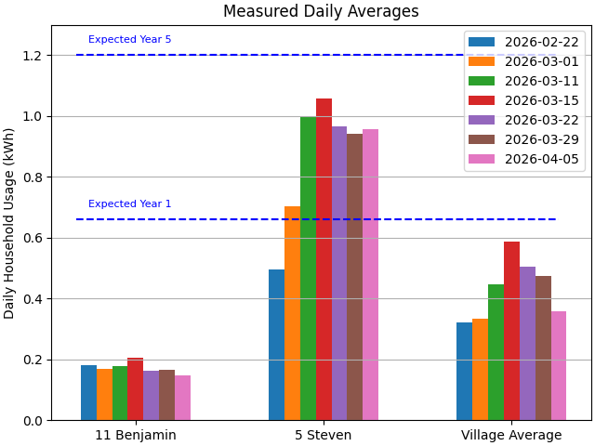
Measured daily household usage for two Morere homes and the village average, compared with the Year‑1 and Year‑5 demand projections.
Energy access through co-design
Underneath all these decisions is a philosophy about how technical development should be done in places like Morere.
Rather than dropping in a fixed, “finished” system, FutureValue and BPP Tech started by asking what people wanted and by studying how similar communities have used electricity in the past. We then used modelling to translate those insights into a first‑pass design, tested that design against multiple scenarios, and adjusted it as new opportunities emerged through the co-design process, like the chiller and VSAT.
That process is not linear. It is iterative and relational. It depends on community members being willing to share how they live and what they hope energy will bring, and on engineers being willing to revisit their assumptions as real‑world data comes in.
For policy makers and funders, this has three significant implications for supporting remote electrification projects like this one.
First, Morere turns ‘learning by doing’ into a repeatable delivery model, giving governments and financiers something concrete they can back in multiple locations.
Second, embedding co‑design in every project is what turns basic energy access into a journey up the energy ladder, from the first switch of lights on to productive use.
Third, just providing energy access is not enough – the end-to-end solution must be relevant for the community context, designed with local needs from the outset, and anchored in building local capacity.
By showing how household demand grows, centralised systems are more cost effective and enabling of growth, and productive‑use loads can be added sensibly, projects like Morere give governments and financiers the confidence to back the next wave of rural electrification.
Morere’s electrification story is still unfolding. But this chapter carries its own lesson: when you start with people, respect the data, and design for iteration, technology becomes more than hardware. It becomes a shared, evolving commitment between communities and those who support them.
Later we will introduce the community energy cooperative that now manages the system, and how families are using power to change their lives.